
Innes Cuthill
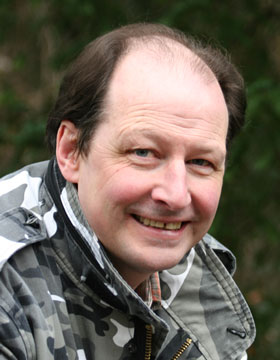
Innes Cuthill has been Professor of Behavioural Ecology at the University of Bristol since 1998. Before moving to Bristol in 1989, he did a DPhil and then held research fellowships at the University of Oxford. Although he has dabbled in various areas of behavioural ecology, for the last 25 years he has been collaborating closely with physiologists, perceptual psychologists and computational neuroscientists to understand how animal coloration (notably camouflage) evolves in response to animal colour vision. Awards include the Scientific Medal of the Zoological Society of London, the first Nature/NESTA mentorship award and the 2018 ASAB medal, having also served as President of ASAB from 2007–10.
Outreach Lecture 2025: Animal camouflage: evolutionary biology meets neuroscience, art and war
Some of the most persuasive evidence for natural selection comes from animal camouflage. However, camouflage is not simply an adaptation to match the background, it is an adaptation to the mind of the species that you are hiding from. Unsurprisingly, given their appreciation of how colour can deceive the viewer, some of the earliest theories animal, and military, camouflage were put forward by artists. However, other species have different types of colour vision from humans, so the modern study of animal camouflage requires that biologists collaborate with neuroscientists and psychologists to understand how animal brains construct their visual world.